
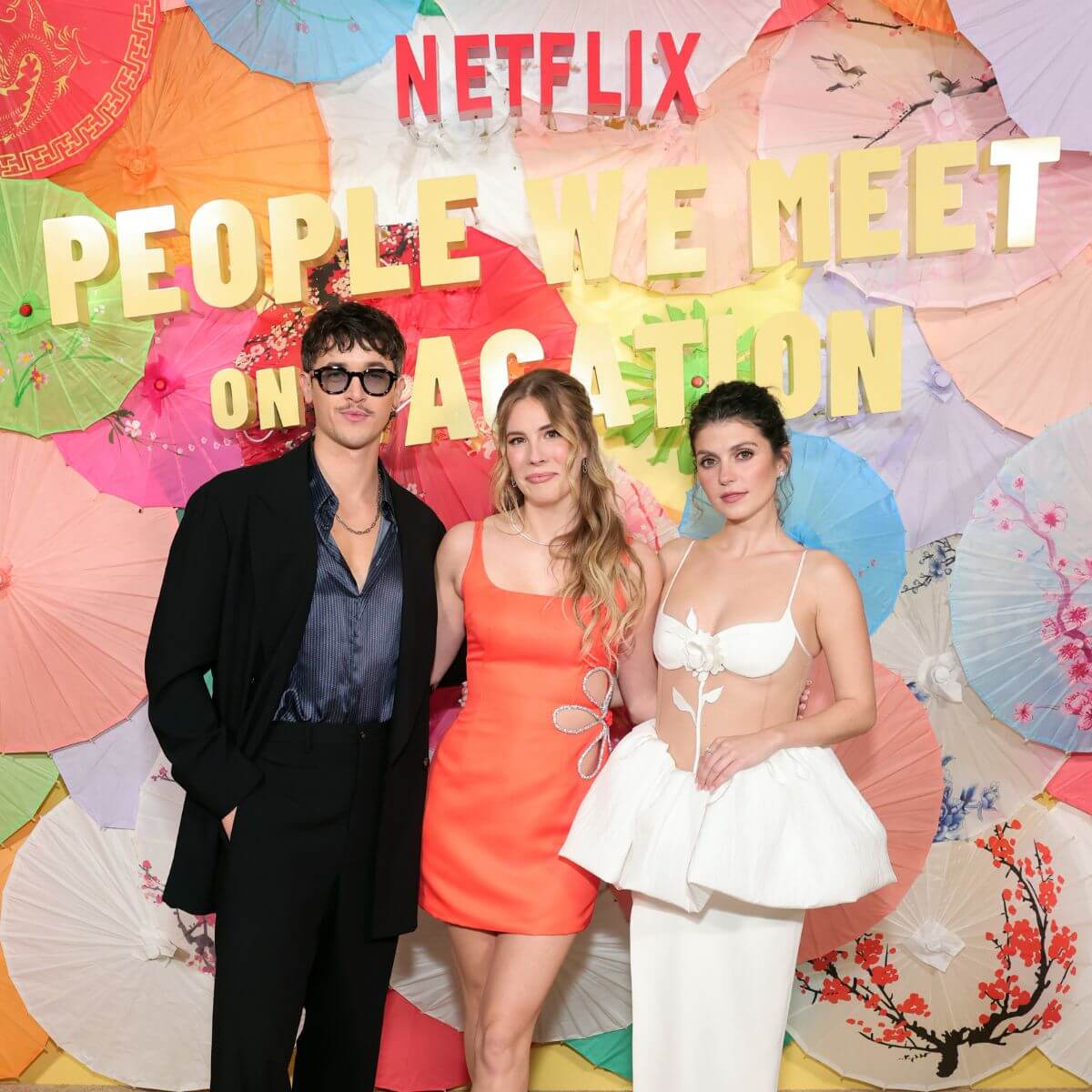
Photo credit: Getty Images for Netflix
It’s no secret that Emily Henry is one of this generation’s most celebrated romance authors, so it comes as little surprise that nearly every one of her novels is being adapted for the screen. When news broke that People We Meet on Vacation was headed to Netflix, our excitement was immediate. After months of anticipation—heightened even further by the casting of Emily Bader and Tom Blythe—the adaptation ultimately delivers. Blending EmHen’s particular brand of banter with screenwriter and author Yulin Kuang’s knack for bringing love to life, People We Meet on Vacation is the perfect blend of quirky coupling and meet-cute mastery readers hoped it would be.
The Book vs. The Movie
This one certainly demanded a reread before the release so we could spot the creative liberties taken by director Brett Haley and screenwriters Yulin Kuang, Amos Vernon, and Nunzio Randazzo. As Emily Henry had shared, there were a lot of new scenes, fresh dialogue and even a huge location shift. Kuang, a long-time Emily Henry fan herself, was intentional about honoring the original source material. In an exclusive interview with She Reads, she had this to say about collaborating with Henry and honoring the shift in medium:
“Emily is everything you’d hope for in a creative partner, as a filmmaker adapting an author. She understands her characters and her audience so well, and advocates for them both with such grace. She also understands adaptation as an art form unto itself and has been so supportive as we do the dirty work of transplanting her stories into the soil of a new art medium.”
While the foundation remains the same—two close friends taking annual vacations together—several notable changes stand out. The film features fewer trips overall, and the Croatia vacation from the novel is condensed into a single Tuscany trip. This choice speeds up the deepening of the relationship between Alex and Poppy, offering a more concentrated emotional arc than the book’s slower burn.

Photo Credit: Daniel Escale/Netflix
Another significant shift is the expanded role of love interests. Friends-to-lovers rom-coms often lean on love triangles as a source of conflict, and the adaptation embraces this trope more fully than the novel. In the book, Poppy’s hesitation stems from her fear of ruining the friendship, not from Alex being romantically involved with someone else. And while Sarah is a common topic of conversation in the book, the bigger role she plays in the film changes the emotional stakes.
As a result of these changes, some of the novel’s quieter, more tender moments don’t make it to the screen. Fans may find themselves missing scenes like the Tinder profile reviews, the full extent of Alex’s gentle caretaking when Poppy is sick, or the deeply personal revelation that Alex had a vasectomy after Poppy’s pregnancy scare, which is rooted in his fear of losing someone he loves, after his mother passed during childbirth. These moments, though small, play a meaningful role in building intimacy and emotional tension in the book.

Photo Credit: Michele K. Short/Netflix
That said, the film retains many beloved elements. Iconic inside jokes (“it speaks to me”), familiar destinations like New Orleans and Canada, glimpses of Poppy’s eccentric parents, a sprained ankle followed by a piggyback ride, and the climactic grand gesture all make appearances. Most importantly, Tom Blythe and Emily Bader capture the essence of Alex and Poppy beautifully, highlighting their differences while making their connection feel genuine as the years pass.
Reader Reactions
Any time a popular book is adapted, skepticism is inevitable. The familiar phrase—the book is always better—quickly surfaced once the film premiered, though we can’t say that we’re entirely surprised. However, social media lit up with truly mixed reactions. One reader on Threads shared, “Even as a newer Emily Henry fan, I was nervous to watch the People We Meet on Vacation adaptation. Spoiler alert: I really, really enjoyed it! I love that it leaves some things just for the book. It feels like a rom-com that truly embraces both halves of the genre and pays homage to the greats, especially When Harry Met Sally.”
Others offered up a more critical response. Another Threads user wrote, “My biggest gripe with the movie is that I wish it were a series and carried more of the emotional weight from the book.”
Perhaps most compelling has been the response from fellow authors, offering rare behind-the-scenes perspective on the adaptation process. Ally Carter commented, “One of these days I may do a 70-part thread on how book-to-film adaptations happen (or, more frequently, don’t happen) and all the many, many, many ways they can go wrong. When I tell you that The People We Meet on Vacation is a MIRACLE film, please know I know what I’m talking about.” Jodi Picoult was quick to agree.
Final Thoughts on People We Meet on Vacation
While die-hard fans may miss certain scenes from the novel, the film does an excellent job standing on its own as a modern-day When Harry Met Sally. It’s clear that Yulin Kuang and Brett Haley worked closely with Emily Henry to strike a careful balance of remaining true to the heart of the story while allowing the adaptation to feel fresh.
For anyone craving a feel-good movie that delivers genuine laughs, heartfelt romance, and classic rom-com charm, People We Meet on Vacation is well worth the watch. And with more Emily Henry adaptations on the horizon, the countdown to the next one has already begun.





Leave A Comment