

From the #1 New York Times bestselling author of Lessons in Chemistry comes her sophomore novel Peck & Peck. As her 1980’s, publishing-set story hits shelves, we had the chance to talk with Bonnie about her move from the tech industry to becoming an author, following up a breakout debut and what inspired her to dive into the poetry publishing industry.
She Reads: Let’s start with Peck & Peck. What inspired this novel?
Bonnie Garmus: To be honest, I’m not really a poetry person, but I was drawn to poetry for a whole bunch of reasons.
One of the first was that I was driving home from work one day when I was living in Seattle, listening to NPR, and they had someone reading a Nikki Giovanni poem on the radio. I hadn’t heard this piece since I was 14, when my English teacher read it aloud to us. Suddenly, all these memories of poetry and what he said about it came flooding back to me.
The poem is really about what constitutes substance in our lives. And at that time, with work, I was asking myself, am I even working with substance? I don’t know. I was starting to really doubt my career.
This was back in 2009, when I was doing a lot of work in technology. I started to feel like technology was shifting from something that had been cool and innovative to something more greed-based and marketing-driven, to be blunt.
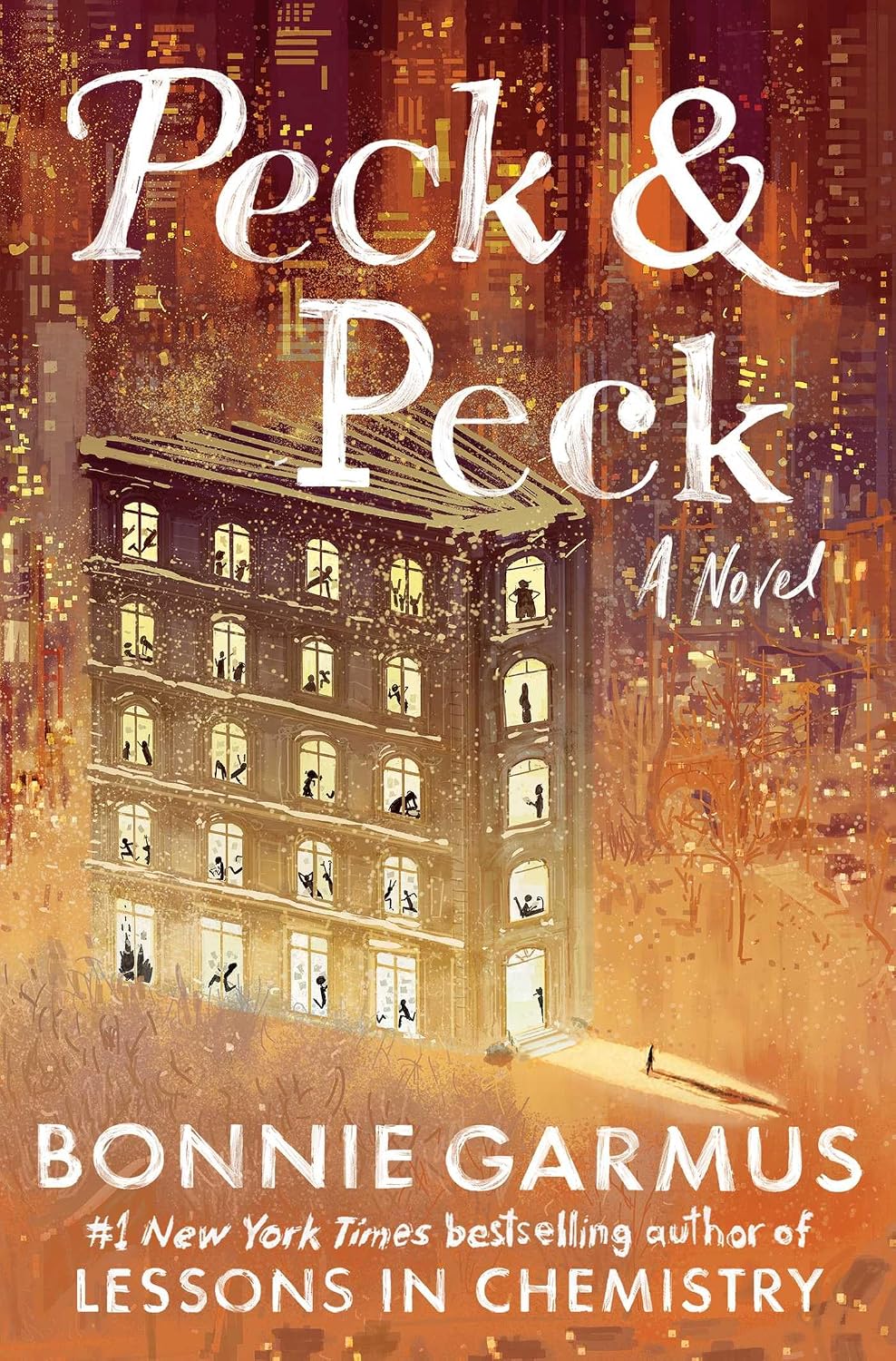
At that point, I had this idea for Peck & Peck. I didn’t follow it right then, but it came back to me after I’d finished writing Lessons in Chemistry, with the rise of AI. It was exactly what we were talking about back then. So that’s where it all started.
She Reads: This must be a really interesting moment for you, watching AI seep into publishing the way it is.
Bonnie Garmus: Interesting is a kind word, I think.
It’s kind of shocking that all of this work was stolen and everyone seems fine with that. It’s legalized, normalized stealing. And I think that’s a really big problem, not only because it’s wrong, but because we’re actually going to face generations of kids who are not allowed to use their imaginations. I find that very disturbing.
She Reads: It’s really concerning. I have to ask you this question. It’s not on my list, but now I’m fascinated. Having been in tech, do you feel like there’s a capacity to pull this back at all? Are there people in there who care about the preservation of art and intellectual property?
Bonnie Garmus: I think there is a chance.
Back when they were talking about it in 2009—and AI has been around forever—everybody acknowledged that it was this loose cannon. Everybody knew it. It wasn’t the sort of thing where everyone was saying, “But we’re going to do it. It’s inevitable.” It was never like that.
So I’ve always been surprised by this attitude of, “Well, it’s inevitable.” I think that’s just the greed kicking in. And taking away our privacy, our governments, our voices—it’s a pretty big deal.
But your question was, are there people in tech who care about the preservation of art? Yes, there are people like that. As much as I say, “What are you guys doing in tech?” I’m glad they’re there because they’re fighting for the right path.
It may not look like it to people outside of tech, and it’s probably not exactly a happy thought that they’re all on stock options and waiting for them to vest. But there are people who care very deeply and who are speaking up.
She Reads: Thank you so much for indulging that tangent. Back to books. After such a female-forward novel with Lessons in Chemistry, what was it like to switch to a male protagonist? How did that shift challenge or inspire you?
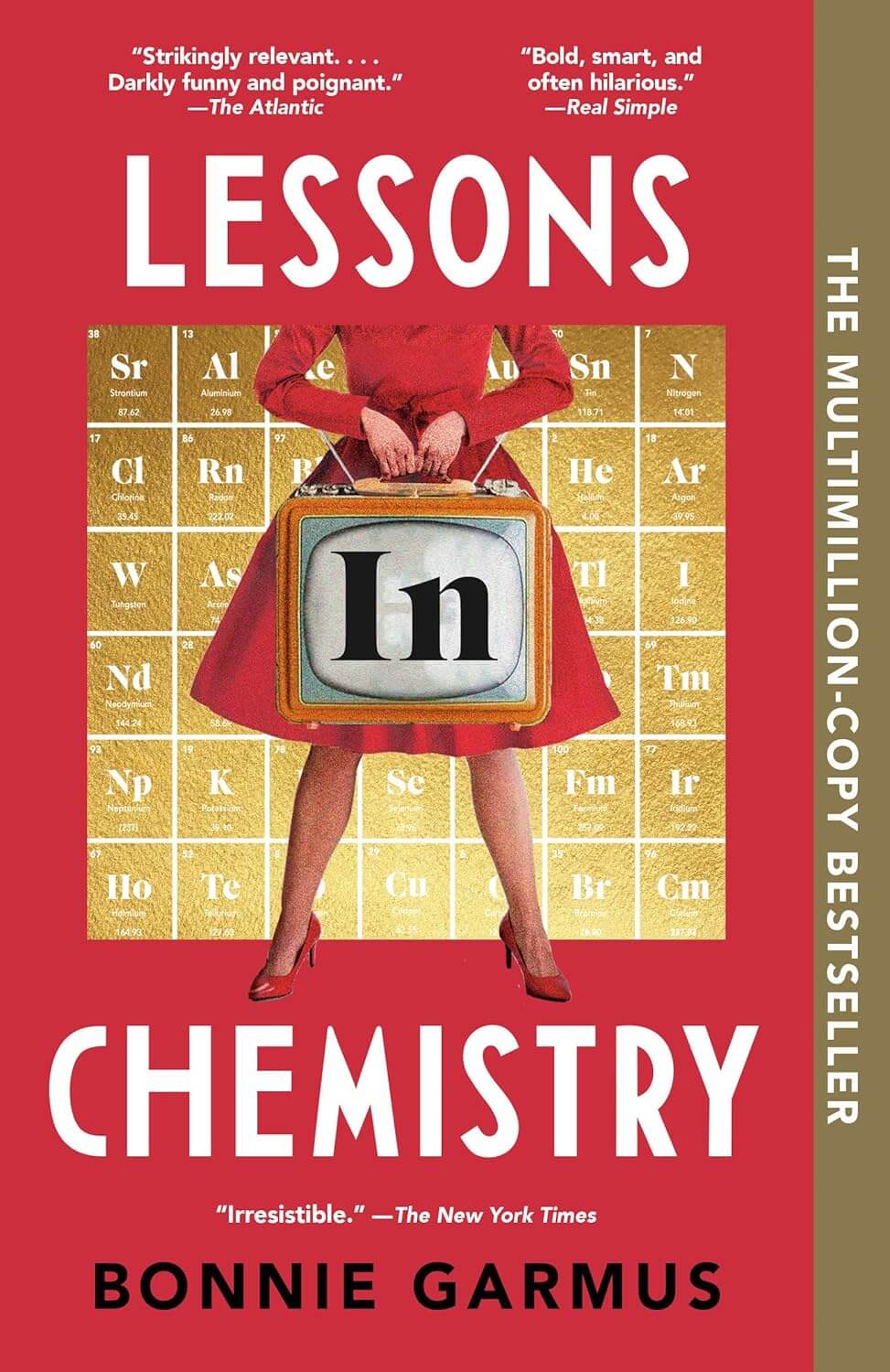
Bonnie Garmus: In Lessons in Chemistry, I wrote from men’s points of view as well. I had four male protagonists in that book, and I wrote from their points of view.
But having this book be only from this one man’s perspective was really interesting. I had not intended to write a male point of view as the only point of view.
Then one day, when I was on an airplane flying to an event for Lessons in Chemistry, I heard his voice so clearly. I started writing down his dialogue. I could hear him. I could feel him. And I thought, “Oh no, shit, it’s gotta be a man.”
But by God, I’m putting another woman in here, and that is his mother. I loved writing her.
It was really clear from the start. I feel like writers should be able to write from anyone’s point of view if they’re good enough listeners.
I have a lot of male reviewers, and I said, “Be tough on me. Did I get it right?” They were tough on me, but I got it mostly right. That was really valuable feedback.
She Reads: You’ve talked about your own experiences facing rejection in publishing and what it took to finally break through. What was it like to turn your creative eye toward that process?
Bonnie Garmus: Whenever I write, I realize something about myself: after all these years, I always write when I’m kind of mad about something, when I have a passion for something.
I have no room in my life for misogyny. I wish none of us did. And I have no room in my life for fake originality or the absolute crushing of creativity. I cannot stand people who are trying to ruin education by making sure no one learns anything again.
Whenever I write, I find that I’m writing about things I’m passionate about.
I always try to put something really positive in my books that I’m passionate about, like rowing, and in this one, typography. So it’s not just me haranguing about things.
But in this particular book, I really wanted to shift my attention to the arts because the arts are always undervalued.
Editors and people like yourself are always undervalued for what you’re bringing to this party. But you guys are the ones who determine what the rest of us read. I think that’s an enormous responsibility, and I love it. I want to celebrate it.
I want to celebrate writers and every kind of artist, really, because, like I said before, without artists, you’re going to have a pretty ugly world to live in.
She Reads: The novel also focuses on who gets to decide what art is made. Take us through your experience dealing with gatekeepers, but also making the art you believe deserves to be made and trusting that it will find its place.
Bonnie Garmus: There are gatekeepers. I’m sure my publishers don’t want me to say that, but yes, there are gatekeepers.
One of the problems now, especially with AI, is that the gatekeepers are being besieged with more queries and submissions than ever before. Even before, they couldn’t handle what they were getting.
They’re expected to go through so many books, read them carefully, and decide what gets put on your list. It’s a big job.
What I really wanted to trumpet here is the effort behind that, but also the fact that they’re faced with these mounds of things that aren’t well written, that weren’t thought out.
In our culture, everybody learns how to write, and pretty much everybody thinks they can write. But writing is a craft, just like anything else.
If you wanted to train to be a marathoner, you wouldn’t run around the block once and go, “Okay, I’m good.” You put a lot of effort into it, years and years and years, because that’s what writing is. It’s practice.
I really wanted to bring that out in the book.
In terms of finding that substance, it takes people with ears. You have an ear. I think editors must have an ear. They must understand what the reading public is interested in.
But even greater is the job of recognizing what they haven’t heard yet that they need to hear. I think that is a skill that is incredibly underestimated.
She Reads: Your book is focused on Batter’s (the protagonist’s) ear. What does it mean to you to have an ear for art, or an eye for art, whatever endeavor you’re in?
Bonnie Garmus: When people say they have an ear or an eye for these things, some people hear that and think, “Oh, it’s genetic. They just woke up one day with that talent.”
But it’s not.
You have read millions of books, probably. Your practice is in reading. That’s what I want to bring out.
It’s no accident that Batter Gray wants to become—not really a poet—but an editor. Because what he has been practicing is not really writing. He’s been practicing that ear, and he’s been practicing it from childhood. That has allowed him to become an expert at this.
But honestly, I think people don’t just have ears. They’ve developed them. The effort they put into doing that is something that needs to be talked about and celebrated.
She Reads: What is it for you, though, that makes you feel that whoosh of connection and awe when reading something?
Bonnie Garmus: I feel that connection when someone has not only gone out of their way to entertain me or keep me really, really interested—which I think is a difficult skill—but when they connect with me on a human level.
I’m emphasizing the word human here.
When they have something to say. It’s not just a story. It’s a story that has something to say.
I really appreciate it whenever I run into that. It’s pretty amazing.
She Reads: You mentioned what inspired you to write a book focused on poetry, which is interesting because it’s such a difficult genre to make commercially successful. You’ve been in publishing from a novel-writing perspective, and now you’ve explored poetry publishing through Peck & Peck. What did you discover about the commercial viability and the tenacity you have to have in poetry specifically?
Bonnie Garmus: I have a couple of poet friends, and they always used to say to me, “Stop whining about being rejected as a novelist. Just stop. Because you will never compete with a poet on rejection. You will never come close to what we get in terms of rejection.”
And I said, “Yeah, but you know what? Your pieces are this big, not this big. Come on, you guys. We novelists have to put in a lot more effort.”
And they’d go, “Hmm.”
But I will say, after having explored poetry—and again, I wasn’t a poetry aficionado. I kind of had to drag myself to it because my character insisted.
When I studied poetry for a full year, and I now read a poem every day courtesy of the Poetry Foundation, I realized, “Oh, I’m such a dolt. I’ve been missing this genre completely.”
I feel like a total idiot now that all of this great work is out there. You can read it in under five minutes, except for some pieces.
I discovered this whole new world of new voices, of incredible craft. I know I don’t have the ability to be a poet. I don’t have the patience to be a poet.
But what really captured me about poetry was how blindingly honest all of it is.
Poems have no reason to lie. In fiction, we’re making up these worlds and everything. In poetry, they’re actually telling you how it is, and they just hit you right between the eyes.
That became more and more apparent to me.
But then I did wonder, because no one reads poetry—I’m sorry, poet friends, but it’s true—we need to change that. I would really like to change that.
Why is that? It’s because people think it’s elitist or boring or weird or whatever. It’s none of those things.
You do have to find poets who connect with you. There’s a huge array. It’s not that hard. But the difference it will make in your brain and in your own life is significant.
It made me start to think about why poetry has never really gone out of style. It’s never gone extinct. Poets keep writing poetry despite the fact that they’re not going to make more than $10.
I gained this huge appreciation for it. It will not go extinct because it evolves.
She Reads: I agree. I love that poets have found a way to take their bite-sized content and mix it with what social media does.
Bonnie Garmus: I listen to this poet, she’s Scottish, Len Pennie. I listen to her deliver one of her pieces, and you’re right, it’s on Instagram or whatever. She just blows me away.
She knows how to read her own work. Some friends aren’t that good at reading their own work. I’m really bad at reading my novel aloud.
But when I hear someone perform their work or someone else’s work correctly, it’s like a blaze sweeping through a room.
I have so much admiration for this skill now, especially because I know I’m not a poet. I can admire somebody else’s skill, and I’d like to crow about it for them.
She Reads: We’ve talked about how Lessons in Chemistry was born out of anger, and you mentioned that Peck & Peck was also inspired by things that made you mad, with typography as one of the positive things you wanted to celebrate. Were there other emotions that bubbled to the surface while writing Peck & Peck that differed from Lessons in Chemistry?
Bonnie Garmus: Very much so.
In Lessons in Chemistry, Elizabeth Zott was very logical. She was very certain of who she was. She didn’t waver from that.
It was a joy to write somebody who really understood who she was and what she stood for.
I switched gears here and created a character who is more of an everyman. He’s not sure who he is. He’s not sure what he stands for.
He has a skill nobody wants, which is this ear for poetry. He feels like a failure. He fails at a lot of things, and he’s constantly kind of covering his tracks. He’ll lie a little bit about what he’s doing because he’s embarrassed.
All of his friends from college are becoming lawyers or doctors or whatever. They’re all on the sensible, practical path to earning a living, and he’s not.
I know so many people in this position.
But I also know so many people who chose the other path, who did become the lawyer or the architect.
I have a very good friend who became an architect, and he recently quit. He was one of the readers on my book, and he called me and said, “Well, because of you, now I’ve quit my job.”
And I said, “Okay, wait, wait. Don’t start there, please. It’s not my fault.”
But he said, “I’ve been an architect for 30 years. I’ve been designing parking garages for 30 years, and I’ve never been happy in 30 years.”
So he finally decided to retire early, and he said, “I’m going to do oil painting.”
I said, “How did you choose that?”
He said, “When I was in college, my goal was to be an illustrator, to be a painter, an artist, and I wasn’t brave enough.”
And I said, “Mostly it’s not that you weren’t brave enough. It’s that the whole world is telling you that the arts aren’t serious enough.”
But they are serious enough.
That’s what he’s doing now, and apparently he’s thrilled to be doing it.
But as he says, “Don’t do what I did. Don’t waste your life, 30 years wishing you’d been someone else.”
I think all of us kind of face that. None of us has a perfect career.
She Reads: Everybody is really quick to judge someone who wants to go into the arts who isn’t quite making it yet, but they’re also thrilled to praise them once they do make it. It’s this terrible trajectory where, when you need the motivation, no one is there to encourage you.
Bonnie Garmus: Oh my gosh, I couldn’t say that better if I tried. It’s so true.
Isn’t it true that no one believes you’ve written something of merit until somebody else tells them that you have?
It is interesting that so many people have to have your work validated by someone else before they can say, “Yes, it is good.” That’s a pity.
When my friend told me about it, the amount of sadness in his voice really struck me. He kept saying, “Well, I had to be sensible.”
And I said, “I’m so tired of people thinking the arts are insensible somehow, or that they’re not the same.”
We need to change the whole structure of how art is rewarded. Why are we paid less?
She Reads: Sensible seems to equal miserable just about 100% of the time.
Bonnie Garmus: Exactly. Rarely satisfied, that’s for sure.
She Reads: Peck & Peck is set in 1982, so you’re looking at publishing more than 40 years ago. In your research, did you discover a huge disparity between then and now, or do you think traditional publishing has remained traditional publishing?
Bonnie Garmus: It’s so funny. They don’t evolve very quickly.
I will say Peck & Peck was not based on any kind of American publishing company, because can you imagine an American publishing journal that only hires editors and there are 39 of them?
No, it would never happen.
But I really wanted to make it like that because I wanted to emphasize how important it is to have these educated people reading work and finding the good stuff, and how they are the heart of the company.
They are the people who determine what the world reads. I wanted that to be loud and clear.
In terms of American publishing, it’ll be interesting to hear what publishers think.
My publisher was fine with it because they didn’t recognize their own company in it. They’re not in it, obviously.
A lot of the book is centered on late-stage capitalism, and it’s a little bit of a political satire because we’re addressing the bullies at work.
We have a lot of bullies in the world right now telling us what to do and how everything is inevitable. And it’s not.
I really wanted to have a guy in charge of Peck & Peck who didn’t know poetry at all. It didn’t seem to be that important to him.
She Reads: What did it feel like writing Peck & Peck after the success of Lessons in Chemistry? No one can really prepare for that. What did it feel like going into the sophomore novel?
Bonnie Garmus: I’m really naive because everyone kept expecting that I’d write the sequel to Lessons in Chemistry, and I kept saying, “I’m not going to do that right now.”
I don’t think they took me seriously.
So I very happily went off and started writing Peck & Peck. I didn’t give it a second thought.
I’m writing about creativity. I’m writing about originality. I can’t do the same thing. That goes against the whole premise of what I’m trying to talk about.
So I went very happily into Peck & Peck.
I was on an airplane when I started it, when I first heard Batter’s voice. From there, it just sort of took off.
She Reads: Is there an intent to do a sequel, or are we just moving through creatively?
Bonnie Garmus: I do have a very strong idea for a sequel. I just knew I couldn’t write it right then.
I knew Elizabeth Zott would keep pushing in, and I want her to.
But the sequel, I know, would center around Madeline Zott. Elizabeth would certainly be part of it, but Madeline would be the protagonist, the main one.
So I have a pretty strong idea about it.
But this other idea for Peck & Peck was ten times stronger, and I thought, “I better go with my gut here on this.”
She Reads: What was the adaptation process like for Lessons in Chemistry? How involved were you? What did it feel like seeing it come to life? Did it feel like someone else’s story by the time it made it to the screen?
Bonnie Garmus: It did feel like someone else’s story, but I was warned about that.
I was warned by really nice authors who called me up and said, “I see that your book has been optioned, and I think it’s going straight into production. So here’s the instruction for what you do now: You turn and you run the other way.”
Because it is your child, and they need to change your child. You just have to let them do that.
I have to say everybody I worked with at Apple and Aggregate Films was absolutely wonderful. I’m very lucky it got made.
Is it the book? No, it’s not the book. It’s never the book.
As long as you go in knowing that, you’re going to survive because it is your child.
I didn’t have anything to do with it. I’m listed as a co-executive producer, and I’m fond of saying that means do nothing.
I did nothing. Literally nothing.
But I’m so lucky it got made. It rarely happens, and it happened to me. I’m exceptionally over the moon about that.
She Reads: Now that Peck & Peck is out, what are you working on next?
Bonnie Garmus: Mostly I’m working on Peck & Peck, getting it off the ground.
I’m about to start a big tour, and that will take up a lot of my time.
But I have an idea—actually, I have about three ideas—for my new book. I just have to see which voice comes at me.
You know how this is. Which one is loudest and says, “No, me, me, me!”
So I’m kind of excited about that.
Peck & Peck by Bonnie Garmus
Batter Gray has recently graduated college, but is struggling to find his place in the world. His friends are moving up the career ladder, while he’s folding shirts at The Gap. Until his opportunity comes along at Peck & Peck, a prestigious poetry publisher and suddenly his ear for the art becomes useful. As he enters the high stakes world where creation and commerce collide, he’s exposed to the intense business behind the beauty.
Buy the book now: Bookshop.org | Amazon






Leave A Comment